


Half of Workers Say They’re Ready to Quit. Here’s Why So Few Are Actually Doing It
Half of Workers Say They’re Ready to Quit. Here’s Why So Few Are Actually Doing It

Peter GrattonThu, August 13, 2026 at 6:59 PM UTC
0
Credit: Joe Raedle / Getty ImagesKey Takeaways -
Nearly half of workers say they’ve recently changed jobs or plan to within six months, but many remain stuck.
Nearly half of applicants say they’ve massaged their materials—mostly by omission, not fabrication—as competition has ramped up for scarce openings.
Job searching has become a daily habit for many American workers. Landing a new job, though, remains the hard part.
That’s according to FlexJobs’ State of the Job Search Report, which shows the low-hire, low-fire labor market continues to frustrate the many workers itching to move on. Nearly half of workers said they recently changed jobs or plan to within six months. More than half said they search for openings every day.
Government data on job turnover tells the other half of the story. The quits rate held at 2.0% in June, and employers hired at a rate of just 3.4%, both near their weakest levels in years, the Bureau of Labor Statistics (BLS) reported last week.
Why This Matters To You
Taking a new job is how many workers land their biggest raises, so a frozen market doesn’t just delay career moves—it slows wage growth across the economy. With pay gains already at their weakest since 2021, so many staying put is a drag on everyone’s salaries.
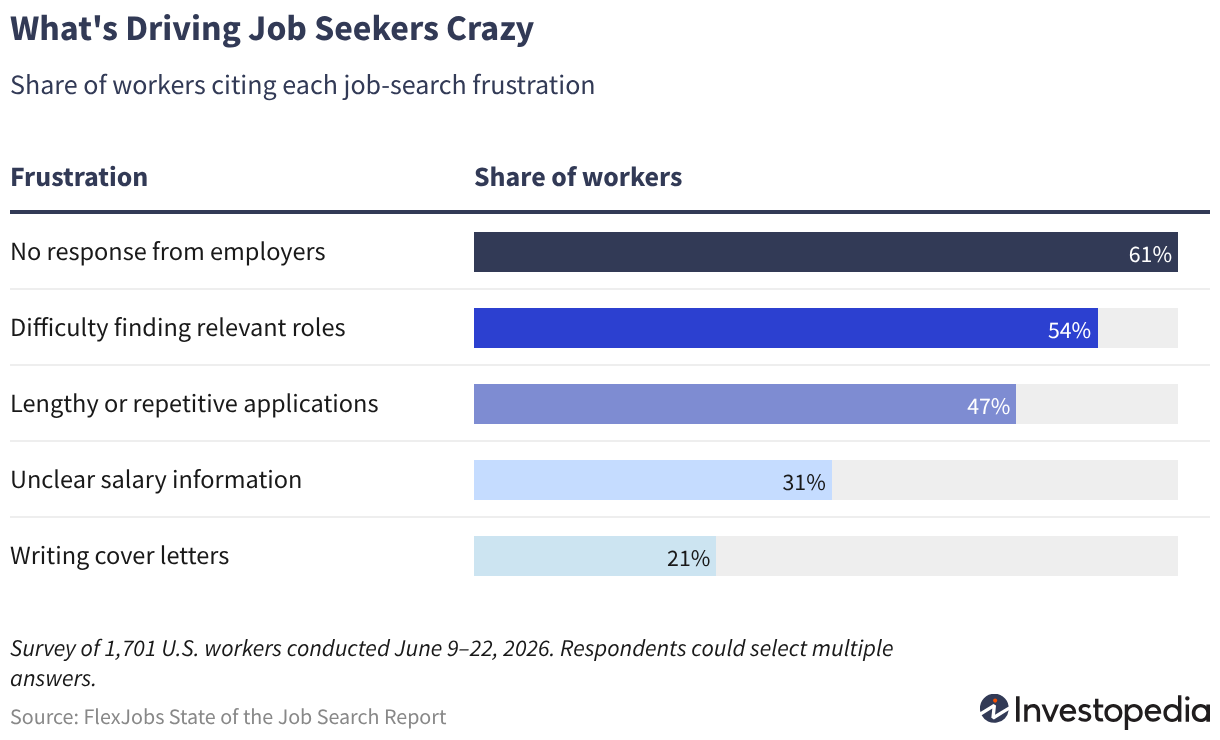
The FlexJobs survey of 1,701 workers, fielded in June, found job searching has become compulsive for many: 37% look for openings multiple times a day.
But all that searching doesn’t have much to show for it. The top frustration, cited by 61% of workers, was employers who never respond, ahead of trouble finding relevant roles (54%) and having to enter the same information repeatedly (47%).
Advertisement
The strain shows in the way applicants apply. Forty-eight percent said they’ve altered or exaggerated information on a résumé or cover letter, most often by leaving out previous roles or experiences or overstating their skills.
About one in four unemployed Americans has been out of work for 27 weeks or longer, according to the BLS’s jobs report for July. Payrolls fell by 23,000, and revisions erased another 103,000 jobs from May and June combined.
Unemployment is still comparatively low at 4.1%, but the low-hire, low-fire pattern that has gripped the market for two years hasn’t budged: layoffs remain rare at a 1.1% rate, and so does hiring. Job openings dropped by about 178,000 in June.
“The way we look for jobs has changed, and in many ways, is proving to be more and more difficult for workers across all career levels,” said Keith Spencer, a career expert at FlexJobs, in a release, adding that candidates now need to be more strategic and persistent to compete.
Workers have more reason to jump: ADP, the payroll processor, said the pay gap between job stayers and job switchers is widening again. Job switchers received raises of 7.0% over the previous year as of July, compared with 4.4% for stayers.
Worker confidence about their career prospects is split almost evenly: 36% feel less confident about their prospects than a year ago, 35% about the same, and 29% more confident, according to the FlexJobs survey.
on Investopedia
Source: “AOL Money”
